Showing posts with label sewing tips. Show all posts

Fun with Bias Binding


Lets take a look at another tricky sewing technique to master, which is Bias Binding.  Of course once you have mastered it you can use it for so many things and so it really is a good one to get to grips with.

Get to grips with Zips

We all know there are some tricky sewing techniques out there and Zips seems to be a popular one, we have a handy Sewing Tips - Zips guide from last year that should help you out to know which zip to use when.

Our Favourite Fabric Shops

This post has been a long time coming! This month was the month that I finally sat down and compiled our list of places we buy the thing we love more than anything else...fabric. You know that H and I both have a love for fabric, print and colour so it is only fair that we share our favourite places to go, to top up our stashes. We would love to know your favourites too, leave them in the comments below...

Makers Month: How to Size Up a Paper Pattern


Being a plus size most of my life, means that most of the sewing I do involves scaling up patterns. Today as we are in Makers Month mode I thought I would share how I do that with one of the patterns I have done this with recently, The Bettine dress from Tilly and the Buttons. This is a great pattern to practice sizing-up on as it is reasonably straight forward to sew and the pattern pieces are simple.


I use a sewing curve, also called a French curve or a pattern master depending on who you talk to about it. It has two straight sides at a right angle and a steep then sloping curve along the other. Mine has lots of helpful measurements and guidelines on it which help with measuring and creating your own curves for pattern making from scratch. I am lazy and generally prefer to alter an existing pattern to making my own from scratch.


Most paper patterns have multi size options printed on the pattern sheets. you can use these to scale the measurements that you will need to use to size up, you will also need dressmakers tracing paper or you can use greaseproof baking paper. I always iron out the original pattern paper and my tracing paper before I start as both have usually been folded in a packet for some time. Take care not to scorch the paper, I usually set it on a wool setting/ two dots. My last tip before we start is to tape down your pattern and tracing paper with masking or washi tape so the layers don't move about until you move them.


Start by taking a look a your pattern pieces, some lines won't move but will need extending, some will need moving and curves will need shifting. Curves (in general) should not need to be altered, you can see that the curves don't change shape they just move, it will be the lines they are connected to that will be moving therefore the curves can just be traced into their new position.  

Your pattern should be taped to your table and the tracing paper placed over the top. 

Photo 1.  Trace all the lines that are not moving, in the case of the Bettine it is the centre fold and the waist, but extend the lines past the edges.
Photo 2.  Mark the end of the lines that need moving, for instance the armpit line where the curve starts. 
Photo 3.  Peel back the tracing paper and measure the difference between the biggest and the next size down. This gives you the measurement for where the next size up line should be. 
Photo 4.  Pop the tracing layer back in place and use the measurement to add as many sizes as need be to your pattern. I have added 3 sizes to mine by moving the line over three times the measurement that I took. 
Photo 5.  Draw your new line up to meet the marking you made for the end of the line, where you new curve will start. 
Photo 6.  Next is the line on the other side of that curve, the bottom of the sleeve. The position of this is affected in two directions, the line moves up and across. 

Photo 7.  You can see here I have added the measurement for one size at a time until reached the size I wanted, I find it easier with those fiddly bits to mark every size increment.
Photo 8.  Again, you want to measure the length of the straight line to where the curve starts.
Photo 9.  Mark clearly where the curve begins. You then want to un-stick your top sheet and slide it over until the curve on the pattern underneath is in line with the markings you have made.
Photo 10.  Then you can trace the curve exactly in place.
Photo 11.  Some lines will be easier to scale, the top edge of the sleeve for instance can be sized up following the diagonal line created by the sizes below.
Photo 12.  Again using the measurements from the sizes below you can add as many sizes as you might need to make your pattern fit your needs.


If you are also looking to lengthen or shorten your paper pattern, the pattern itself may have markings on it where you can do so. Tilly's helpfully do, so all you would have to do here is measure how much longer you want your finished garment to be and add in a section by allowing for that in your traced pieces. If you forget to add it whilst you are tracing, you can always go in and add in a section by cutting and taping an extra piece in place of by folding the pattern at that point.

This process is the easiest, most accurate way to size up or down that I have found but it is lengthy to explain. I do hope that my explanation is clear enough to follow and use for your own pattern sizing experiments. If you are unsure check out this article from Craftsy.com for another style of up-sizing. 

If you have any questions, feel free to ask in the comments and I will do my best to answer them. If you are interested in Tilly's patterns we now stock the full range of printed patterns at Sew Crafty Online. Tilly has a great post on her blog about adding a seam allowance if the pattern you are using doesn't have one (all Tilly patterns have the allowance included) if that is something you are interested in. 

I hope that might help any of you that are above or below standard pattern sizing but desire a handmade wardrobe. 

Sammy xxx

Bloglovin / Twitter / Facebook / Pinterest / Google+ / Instagram

Sewing Tips: Bias Binding

At Sew Crafty I get asked a lot about bias binding, like how to use it and what it's for, which is understandable, if you have never been taught about it, it may seem like a bit of a mystery. I love how it can take a project from okay through to polished and it really isn't as complicated as it may appear. So I thought for this month's sewing tips post I would write a definitive post including everything you ever wanted to know about Bias Binding.

How to Fall in Love With Your Sewing Machine

Did you get a shiny new sewing machine for Christmas? Do you have one, unloved and sitting in your cupboard? Nervous to get it out of the box? Please don't be, your machine can be your best friend if you learn how to love it. A lot of our customers in Sew Crafty tell me that they are a little intimidated by their sewing machine. They are afraid of doing something wrong and not being able to fix it. They find it frustrating and complicated, who has time for that!

Today I am going to let you in on the secret (not a very well kept one) that I tell all of my customers, a tool that is invaluable when tackling a sewing machine, whether you are new to sewing or an old hand. The best news is that you may already have one.....

Your instruction book.

Yes, Seriously, your instruction book. Now don't panic, if you have not a clue where yours is you can usually download the one for your model on the manufacturer's website. Take a note of your make and model and google away, for instance I have a Janome 525s so I would google 'janome 525s instruction manual' and you should be able to get a hold of it that way.  Usually as a PDF so you can print it off if you like too.

Now that you have your instructions at hand you can use them to find out most any thing you need to know. Most instructions don't just have set-up directions but usually they will talk you through all of the techniques that your machine can handle; including zips button holes and decorative stitching. It will tell you what presser feet you have and what they are used for and what settings you need to use for which fabrics. Mine even has a handy trouble shooting guide in the back.

I know that all the information in the manual can be a little overwhelming at first, but learning to drive a car is complicated until you learn how. Here are my top tips to get started:
  • Take some time out to get to know your machine and the techniques it is capable of. 
  • Use fabric scraps to practice stitches so you don't mess up your projects.
  • Don't rush, push, force, hurry or pull. No one likes that!
  • Always use the best needles and thread you can afford, your machine will thank you for it.
  • Change you needle regularly. 
  • Make sure you buy the right bobbins needles and feet. Take one that came with the machine along to your haberdashers with you to double check. 
  • Make a note of your make and model to keep in your purse when shopping for machine parts. 
  • Take good care of your machine. Find the name of a local sewing machine engineer and have your machine serviced after your guarantee ends. Then every two years after, regardless of how much you use it (even more important if it has not been used)
  • Set aside some time before you start a project to practice the steps you will need, practice makes perfect. 

I hope that has encouraged you to get your machine out from where it is hiding. Trust me, it could be the start of a beautiful friendship. Why not have a try this weekend? Do let us know how you get on.

Is there anything you want to know about starting to sew with a machine? Ask your question in the comments and we can see if we can help.

Sammy xxx


Bloglovin / Twitter / Facebook / Pinterest / Google+ / Instagram

Understanding a Dress Pattern Part 1

Dress making patterns can be intimidating if you have never worked with them before. There is a lot of information on the outside and inside of a pattern envelope that needs to be taken into consideration and is essential to knowing whether the pattern will work for you. We sell lots of patterns everyday in Sew Crafty, and I have been working with patterns since I was little so I thought I would share some of the tips I have learned over the years to help you understand how they work and how to choose the one that is right for you. (Please bear in mind that some of the sizing information is relevant to the UK only)

The Basics
Searching for your pattern : You can search either in store via catalogues or online via the pattern company websites. I prefer to use the catalogues as you can gain more information from them and I find it easier to compare patterns to one another if I can see the actual product. Most stores that sell patterns have a variety of books to choose from, for instance at Sew Crafty we have New Look, Simplicity and McCalls patterns in stock and have Vogue and Butterick catalogues with the patterns to order. Usually you will search through the catalogues to find the design you like, then the sales assistant will find the pattern envelope in the stock drawers for you in the size that you need. 

Sizing : Check that the pattern is available in your size. We find that patterns come up at least one size smaller than you would buy in say Marks and Spencer's or Topshop. You can check your measurements for sizing in the back of the catalogues for a general guide, and specific sizing on the pattern itself. A good general rule to follow is that if you usually buy a size 12 in a ready made garment you will be best making a size 14 in a pattern. Luckily most patterns come in multi sized groupings, for instance (8-14) - (14-24) so you can be a little flexible. Be aware that the back of the pattern envelope will give you details for all the sizes, only the front will tell you the grouping you are buying. 

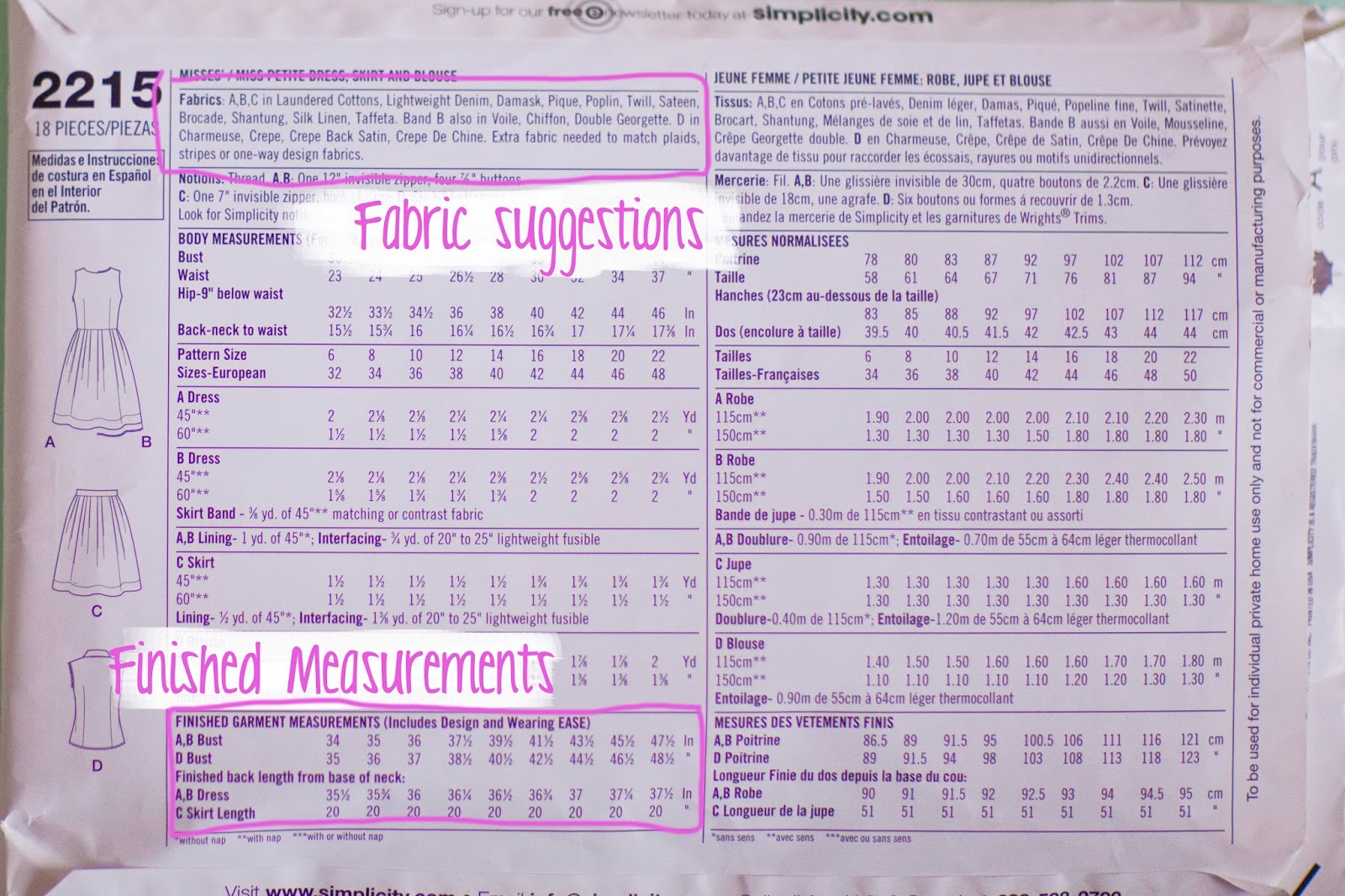
Measurements : The other thing that can be helpful when looking at size is taking your measurements before you go to look for patterns. Knowing your measurements in inches and cm is helpful when trying to choose a pattern. The garment measurements and size measurements are usually listed on the back of the pattern envelope (if not they will be on the instructions) and will give you a good indication of the size and length of the finished garment. This will let you know what the fit of the garment is like too, whether it is designed to be a tight  fit, or a loose baggy garment, how full the skirt will be etc.

Fabric : If you want a pattern to make a cotton dress, picking a design that is shown in thick wool is not going to work very well. Try and be guided by the fabric suggestions on the pattern envelope.

Style : When shopping for clothes we try and choose styles that suit our figures, do the same with patterns. You will never get a good result if you pick a style that is not what you would usually wear. 

Over ambitious : Try to pick a pattern that is relevant to your experience. If you choose a pattern that has lots of pieces and detailed seams, as a beginner, it can be too complicated and will end up being frustrating. Work your way up to details like pin tucks, detailed seams, intricate collars and sleeves. If you learn a different technique every time you try a pattern you will get a better result than trying to learn everything at once.

Catalogue drawings : Don't let the drawings or photographs in the catalogues put you off. I try to look at the small line drawings at the bottom of each page to get an idea of shape, rather than being put off by a fabric choice or an exaggerated illustration. 

This is Part 1 of 3 the next section which will explain more about the pattern envelope and what all that information is for. Parts two and three are now available to view, Part 2 here and Part 3 here.

Sammy xxx 

If you liked this post and like our blog, please pop over and vote for us in this years blog awards.
To keep up with all our latest posts follow us on Bloglovin

Top tips for Buying Fabric

My love of fabrics goes back to childhood, my Mum was a costumier in the West end at the beginning of her career and always made her own and my clothes when I was a little girl.  She used to take me with her to go fabric shopping and I remember spending many a happy hour in the shop that we now own together.  Print, colour and texture have been a part of my life for as long as I can recall, choosing fabrics to sell at Sew Crafty is one of the things I love most about my job.
We get questions on a daily basis about how to choose the right fabrics for a pattern and where to buy unusual fabrics from, these are my top tips for buying and choosing fabrics. 

1. Ask advice : Usually (although not always) the sales assistants who work in fabric shops and haberdashery departments have a great wealth of knowledge that you can use to help you choose the fabric that is right for you.  Don't be afraid to ask for help, more often than not they will enjoy guiding you through and helping you choose a fabric for your project. 

2. Quality costs : In general cheap fabrics will produce cheap results. If you are going to take the time to make something, you want it to last. My advice is to buy the best quality you can so that the result will be a good one. If you are worried about using an expensive fabric on a project you are unsure about, try having a trial run.

3. Trial run : Having a trial run at a new project or pattern is a great way to get all the mistakes out of the way and learn where extra care needs to be taken.  In dressmaking this is called a toile.  If I am making up a new dress pattern that I have never done before I will make it up in a cheap fabric to see how it works.  If I don't like it or need to make a smaller/bigger size I can make adjustments before committing to making it in a more pricey fabric. 

4. Check your pattern : If you are making a garment from a pattern, there will be a section on the back which gives you an indication of the kinds of fabric that the pattern was designed for, use this as a guide.  This is particularly important when using Stretch fabrics/patterns.  The rule usually works that you can make a non-stretch pattern in stretch fabric, but it is much harder to make a stretch pattern in non stretch fabric (not impossible but a lot of adjustments would have to be made) So it is important to read the fabric recommendations carefully before buying your pattern as well as your fabric. 

5. Colour : Colour is something to be very aware of when buying fabric online. Colours can appear differently when photographed and different again when shown on a computer screen.  If you are unsure of the colour you are wanting to buy, especially when you are trying to match a colour, ask them to send you a sample before you commit to a full length, this may not be free, but better than spending lots of money only to be disappointed.  If it is good and you do want to go ahead, some places will credit the amount you paid for samples from your purchase.

6. Samples : Most places will give samples, as I said they may not be free though.  If they are free, don't be cheeky and ask for too many.

7. Width : Checking the width of the fabric is important and with buying cotton or quilting fabrics online, you often will buy it by the fat quarter rather than by the metre so check the measurements of what you are buying carefully before you hit that checkout button.  If you are buying from a shop it will be easier to see what you are getting, but don't be afraid to ask to see an amount before they cut to be sure it is enough to complete your project.

8. Pattern repeat and placing : Depending on the size of the print on your chosen fabric you may need to consider the distance between the repeat.  This is particularly important with large floral prints and checks (like Tartan) when you are making a dress or trousers.  You want the side and back seams to match up so you will need to take this into consideration when working out your amounts.

9. Nap : In a similar way to your pattern repeat, if you fabric has a pile, like velvet or corduroy, they have what is called a Nap. If you stroke the fabric in one direction it will feel smooth and in the other it will feel rougher. You will want to buy enough fabric so that all of your pieces can face the same direction.  Normally with these fabrics you want the smooth direction going up the garment.  It makes the colour look richer when you are wearing it.

10. Washing instructions : If you are lucky, the price label on the fabric will also have advice for washing.  If it doesn't ask the assistant if they have any advice, as you don't want to buy dry clean only fabric for an everyday skirt.  Some fabrics will need washing before you make them up as they may shrink on the first wash. I always wash all my fabrics, whether they need shrinking or not as they can often be dusty from being in shops and warehouses on their travels.  Also it can make some fabrics easier to work with once washed.  I wash them at the temperature I think I will be washing them at when they are made up, so 30 degrees for accessories and furnishings and 40 degrees for clothes. 

Before I go, I thought I would tell you some of mine and H's favourite places to go fabric shopping. You can take a look and try out some of the tips from this post. 


If you have any other questions about shopping for fabric, leave us a comment and we will try and answer your query.  Do you have any tips of your own? Where are you favourite places to shop for fabric? Let us know, we want to visit!
Sammy xxx