Showing posts with label paper pattern. Show all posts

Makers Month: How to Size Up a Paper Pattern


Being a plus size most of my life, means that most of the sewing I do involves scaling up patterns. Today as we are in Makers Month mode I thought I would share how I do that with one of the patterns I have done this with recently, The Bettine dress from Tilly and the Buttons. This is a great pattern to practice sizing-up on as it is reasonably straight forward to sew and the pattern pieces are simple.


I use a sewing curve, also called a French curve or a pattern master depending on who you talk to about it. It has two straight sides at a right angle and a steep then sloping curve along the other. Mine has lots of helpful measurements and guidelines on it which help with measuring and creating your own curves for pattern making from scratch. I am lazy and generally prefer to alter an existing pattern to making my own from scratch.


Most paper patterns have multi size options printed on the pattern sheets. you can use these to scale the measurements that you will need to use to size up, you will also need dressmakers tracing paper or you can use greaseproof baking paper. I always iron out the original pattern paper and my tracing paper before I start as both have usually been folded in a packet for some time. Take care not to scorch the paper, I usually set it on a wool setting/ two dots. My last tip before we start is to tape down your pattern and tracing paper with masking or washi tape so the layers don't move about until you move them.


Start by taking a look a your pattern pieces, some lines won't move but will need extending, some will need moving and curves will need shifting. Curves (in general) should not need to be altered, you can see that the curves don't change shape they just move, it will be the lines they are connected to that will be moving therefore the curves can just be traced into their new position.  

Your pattern should be taped to your table and the tracing paper placed over the top. 

Photo 1.  Trace all the lines that are not moving, in the case of the Bettine it is the centre fold and the waist, but extend the lines past the edges.
Photo 2.  Mark the end of the lines that need moving, for instance the armpit line where the curve starts. 
Photo 3.  Peel back the tracing paper and measure the difference between the biggest and the next size down. This gives you the measurement for where the next size up line should be. 
Photo 4.  Pop the tracing layer back in place and use the measurement to add as many sizes as need be to your pattern. I have added 3 sizes to mine by moving the line over three times the measurement that I took. 
Photo 5.  Draw your new line up to meet the marking you made for the end of the line, where you new curve will start. 
Photo 6.  Next is the line on the other side of that curve, the bottom of the sleeve. The position of this is affected in two directions, the line moves up and across. 

Photo 7.  You can see here I have added the measurement for one size at a time until reached the size I wanted, I find it easier with those fiddly bits to mark every size increment.
Photo 8.  Again, you want to measure the length of the straight line to where the curve starts.
Photo 9.  Mark clearly where the curve begins. You then want to un-stick your top sheet and slide it over until the curve on the pattern underneath is in line with the markings you have made.
Photo 10.  Then you can trace the curve exactly in place.
Photo 11.  Some lines will be easier to scale, the top edge of the sleeve for instance can be sized up following the diagonal line created by the sizes below.
Photo 12.  Again using the measurements from the sizes below you can add as many sizes as you might need to make your pattern fit your needs.


If you are also looking to lengthen or shorten your paper pattern, the pattern itself may have markings on it where you can do so. Tilly's helpfully do, so all you would have to do here is measure how much longer you want your finished garment to be and add in a section by allowing for that in your traced pieces. If you forget to add it whilst you are tracing, you can always go in and add in a section by cutting and taping an extra piece in place of by folding the pattern at that point.

This process is the easiest, most accurate way to size up or down that I have found but it is lengthy to explain. I do hope that my explanation is clear enough to follow and use for your own pattern sizing experiments. If you are unsure check out this article from Craftsy.com for another style of up-sizing. 

If you have any questions, feel free to ask in the comments and I will do my best to answer them. If you are interested in Tilly's patterns we now stock the full range of printed patterns at Sew Crafty Online. Tilly has a great post on her blog about adding a seam allowance if the pattern you are using doesn't have one (all Tilly patterns have the allowance included) if that is something you are interested in. 

I hope that might help any of you that are above or below standard pattern sizing but desire a handmade wardrobe. 

Sammy xxx

Bloglovin / Twitter / Facebook / Pinterest / Google+ / Instagram

Makers Month: By Hand London

Today we want to talk about an independent, British company that we adore! Why do we love this company? Well, it is run by three super stylish ladies with tonnes of talent and vision. Two years ago they started a company and launched a kick-ass dress pattern range and with the help of a Kickstarter campaign are now embarking on bringing 'print your own designs' digital fabric printing right here in Great Britain. What is not to love!?

This photo from 'By Hand London' taken by Richard Round Turner.
By Hand London was created and is run by the gorgeous Charlotte, Elisalex and Victoria. The trio based in London create patterns based on classic silhouettes, uniquely named after the stylish ladies they know and admire. 


 ''We celebrate making, individual style and creative women, designing for those who love to dress up, stand out and customise their own wardrobe''

We took some time earlier in the week to have a chat with them about their experience with crowd funding program Kickstarter and how it has helped them achieve the dream of producing their fabric line and letting their customers create their own designs too. 


When did the idea for a fabric line become the next step for By Hand London, or was it always part of the plan?
It definitely was not on the agenda when we first launched, but was quickly established as Phase 2 just over a year ago when we had started to get into the swing of producing patterns. It seemed like a logical, and very exciting step - and we became all the more eager to get it off the ground as we saw companies like Spoonflower in the US doing so well.

What made you choose Kickstarter/crowd-funding rather than searching out private investors?
The wonderful thing about crowd funding is that it allows small companies to test the waters with a new (and very expensive) master plan. Just the fact that we made our target, shows us that there’s a big market for a print-on-demand fabric service and this will hopefully build our company to a point where we might be more attractive to investors. Needless to say, as a small company the last thing we want to do now is sign away all the equity! Crowd funding also serves as an indispensable PR tool and reaches out to a huge amount of people in anticipation of the Big Master-plan.


What are the main things you have learnt from the experience of using crowd funding?
Ummm…. Mainly that a good supply of Valium is definitely in order to keep the mini heart attacks at bay! Just joking - no Valium for us, but not joking about the mini heart attacks! The 30 day period that our campaign was live was possibly the most tense month of our lives - and this “Will we get it? Won’t we get it??” anxiety is completely unavoidable with an all-or-nothing crowd funding platform like Kickstarter. The only way we got through it was by keeping busy - hustle, hustle, hustle! Stay positive, stay proactive and if it all gets too much - take a well deserved break. Do everything in your power not to let the stress taint your working environment. It’s all about morale!

Is there anything you would have done differently?
Loads! We got so caught up in the fun of making the video and planning the launch that we may have run out of time to do some the more obvious things, like prepare press releases! Once it all kicked-off (‘scuse the pun) we were kind of left scrambling to actually let people know what we were up to! All’s well that ends well, though - despite our lack of forward planning we still made our goal and more! Phew!

What exciting things should we be looking out for from you girls in the future? 
Ooooh where do I begin?! The fabric printing will be very exciting and we’ve got loads of amazing artists and designers creating bespoke designs for us, as well as some fun fabric-related projects lined up too. We’ve also got five killer new patterns in the works, a DIY Weddings series for the blog, among other things. One thing’s for sure, life certainly won’t be boring here at BHL HQ over the coming months!

Both H and I really admire these girls passion and drive. They are super role-models for our industry and a great example of what can be achieved with a little style and a lot of determination. I contributed to their Kickstarter campaign and literally can't wait to see what these girls do next.

Want to find out even more about By Hand London head to their website, where you can also buy their stunning range of dress patterns. We also stock the full range at Sew Crafty, and they will be available on our online store when it opens soon.

Have you made any of the girls gorgeous patterns up? Do add a link in the comments below to pictures or blog posts so we can see how you got on.

Are you off to the Handmade Fair this weekend?? Let us know how you got on over on Twitter or Facebook.

Sammy xxx

Watch out for the last Who's Who of Makers Month next week if you like a bit of fabric printing.

 Live, Love, Make, Like, Share, Follow, Tweet, Pin, Add, Enjoy. 

Bloglovin / Twitter / Facebook / Pinterest / Google+ 

Understanding a Dress Pattern Part 3


Welcome to part 3 of 'Understanding a Dress Pattern' this week we are going through what's inside of the envelope. Having followed all the information in the first two parts about how to choose your pattern and how to find out what you need, lets get stuck in to how to make your garment.

Inside the envelope you will find the pattern instructions and the pattern tissue pieces.

The Pattern Instructions
If you take out your instructions the first page will show you line drawings of all the designs, a drawing of all the pieces and which design they belong too. From this you can sort out which pattern pieces you need to cut from the tissue pieces.

Next to that there will usually be a glossary of terms and directions. If you are new to patterns it is a good idea to have a thorough read of this before you start, it is always there for you to refer back to if there is something you don't understand.

Underneath all that will be your cutting lay outs, the blueprints if you like for where you need to place your pieces on your fabric. Again there will be options for different widths of fabric and sometimes sizes. Find the layout that is relevant to you and use that to place your pattern.

The Pattern Tissue
Having read the first part of your instructions, you can unfold your pattern tissue and roughly cut the pieces you need for your chosen design. Although, I usually don't cut the tissue, to make my patterns last longer I use greaseproof paper and trace over the pieces to create copies, leaving the original intact.

This just means that I can always go back to the pattern at another time and make a different size or variation and not have cut away anything I may need. (If you choose to copy, make sure you are accurate and that you copy all the information that you need from each piece) The markings on a pattern can be overwhelming as there are so many with multi sized patterns, but if you have read your glossary it will become clearer. you can always refer to that if you are unsure.

Back to the Instructions
The next step is to start following the instructions, I usually go through them and mark (in pencil) all the parts that are relevant to the design I am making before I start so it is easier to follow as the instructions for all the garments in your pattern are together on the sheet and some steps will be the same for multiple garments. By highlighting (in pencil) the ones you need you can easily ignore the ones you don't need this time.
Once you have read through the instructions you can go to cut out your pieces and start creating your garment. Make sure that the fabric is folded correctly and they you are cutting the right amount of pieces. Having read through the instructions it will have given you a better understanding of how all the pieces go together and you can start to construct your garment with more confidence.

Learning how to use a pattern is one of the best things I ever did, I am so grateful that my mum taught me from an early age. The thing I like most about making clothes is that you end up with clothes that are totally unique to you, with your choice of style and fabric.

I hope that was helpful to you if you are thinking of having a go at making something from a pattern, and that it has made it a little easier to follow. Is there anything else that you are interested in knowing about patterns? leave a comment and I will try and answer you query, If I think others might be interested I will write a post about it. Check out part 1 here and part 2 here, also check out our post about choosing fabrics from last year.

Sammy xxx

Don't forget to follow us on Bloglovin

Understanding a Dress Pattern Part 2

Last week I spoke about how to choose a dress pattern, this week I am going to give you some of my tips on how to read a pattern. As I said last week, Patterns can be intimidating if you have never used one before, but once you know what you are looking at it becomes a whole lot clearer.

Try and think of your pattern as an instruction manual. The information is split up in to different parts to guide you through the process you will need to buy your materials and construct your garment. 

The Pattern Envelope
The front of the envelope will have the picture of all the garments you can make from your pattern, it will also have the pattern number and the sizes that you can make from it.


The back of the envelope is where it can start to look a little scary. There is a lot of information here, some that you need and some that you don't.

It can be more complicated for us here in the UK because most patterns are printed in the USA where they still measure in imperial (inches and yards) and mostly shops in the UK we sell by metric ( metres and centimetres) Don't panic. They will always print the metric amounts on the pattern envelope ( unfortunately on the French side of the pattern ) 

First you need to decide which of the designs within your pattern you are going to make. You can see small drawings on the left which will show you the difference between the styles and give you a letter code for that style, it may be a neck line or a sleeve option or a length option. The image on the front may also give you the letter codes you need to identify the style. Then you can work out the size you need to make, as I mentioned last week, this is important as pattern sizing is not relevant to shop sizing.

Go by your body measurements and make the size that will fit you, you can always take it in a little if it's too big, but if it's too small it wont fit at all.

By following down the column under your size you can see how many metres of fabric each design takes. By matching up the letter code for your choice of design with the your size column you can see how much you need to buy. Your pattern may give options for different widths of fabric, usually 115cm (45'') or 150cm (60'') so you will need to check which width your chosen fabric is before you buy so that you get the right amount. once I have bought the pattern I often use a highlighter to mark the column with my size so it is easier to follow in the future.

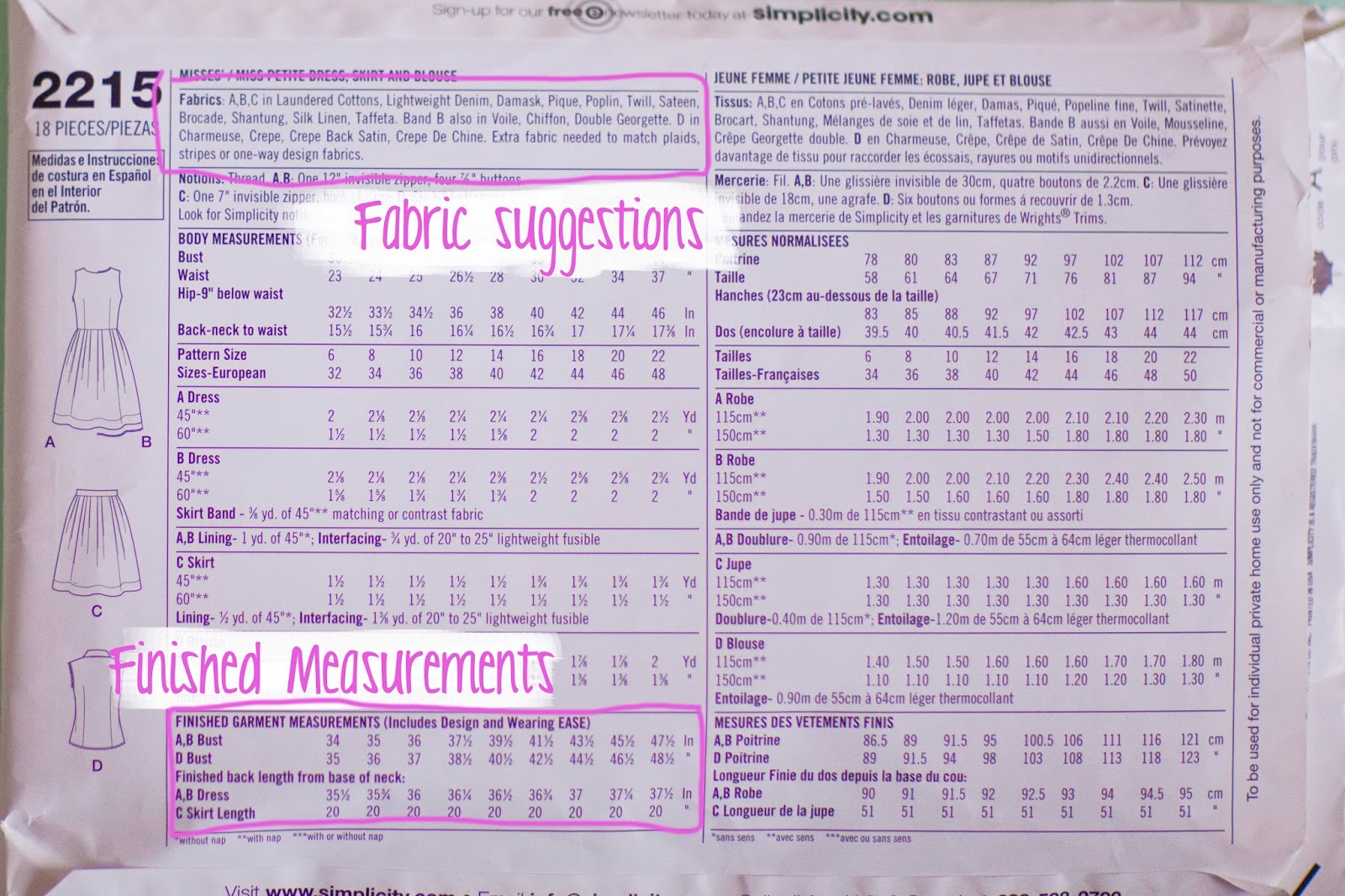
Also on the back will be a suggested fabrics section where you will find some suggestions for the kinds of fabrics that the pattern is designed for and the Garment measurements, which will give you an idea of the fit of the garment (whether it will be tight or loose and the length)

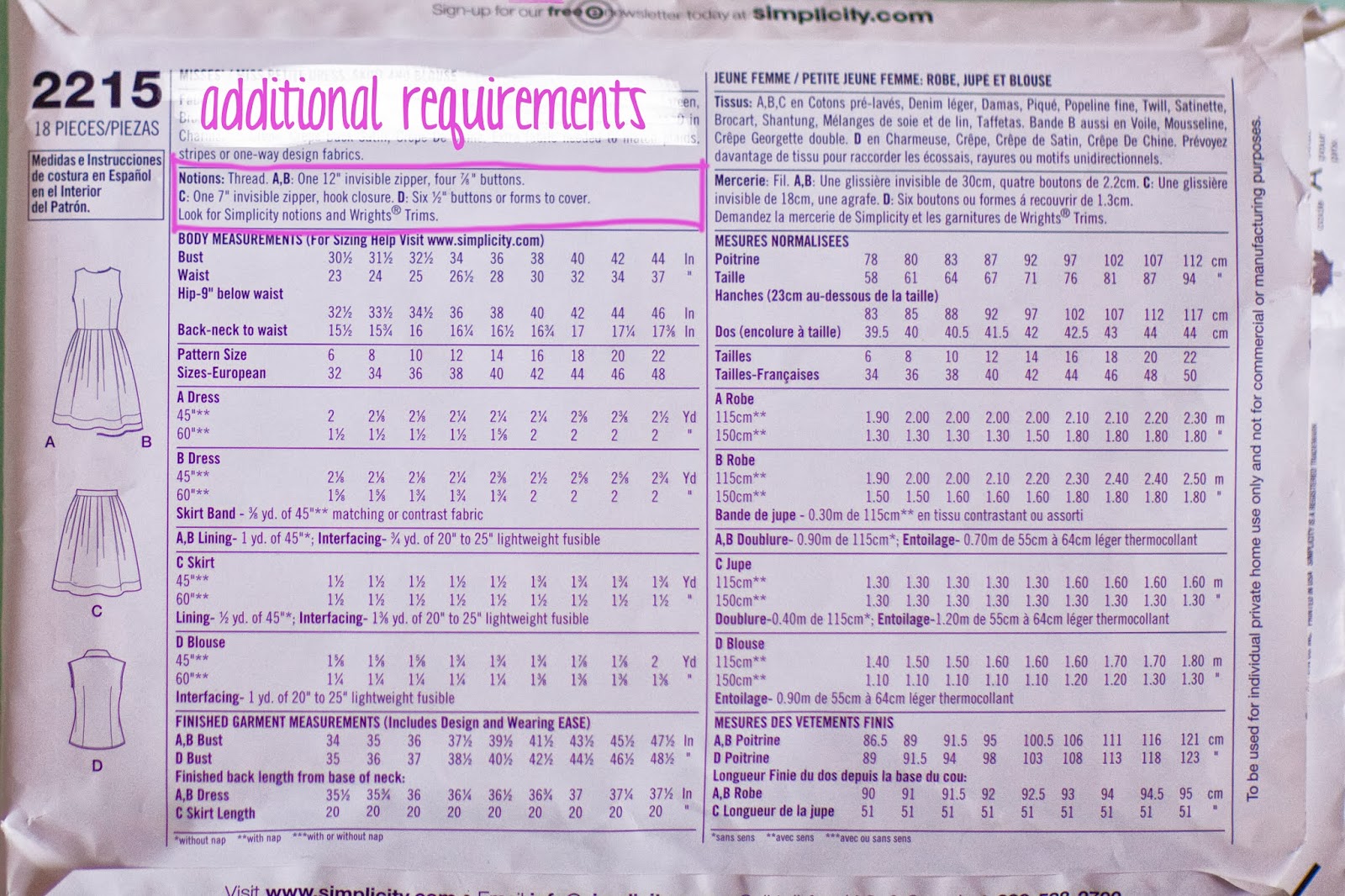
Lastly you will find the requirements section (sometimes called notions) which will tell you what else, other than fabric, you will need to complete the pattern. This is where you will find what size zip, buttons or elastic you need and any additional trims etc.

Usually, if your pattern requires interfacing and occasionally trimmings, they will be listed under the letter listing for each design. 

By following the back of the envelope you should have all the items needed to make your garment.

That's a lot of information to take in so I'm going to leave it there for this week. Next week we will cover the inside the envelope, pattern instructions and the pattern tissue. Check out part 1 here and part 3 here.

Sammy xxx


Understanding a Dress Pattern Part 1

Dress making patterns can be intimidating if you have never worked with them before. There is a lot of information on the outside and inside of a pattern envelope that needs to be taken into consideration and is essential to knowing whether the pattern will work for you. We sell lots of patterns everyday in Sew Crafty, and I have been working with patterns since I was little so I thought I would share some of the tips I have learned over the years to help you understand how they work and how to choose the one that is right for you. (Please bear in mind that some of the sizing information is relevant to the UK only)

The Basics
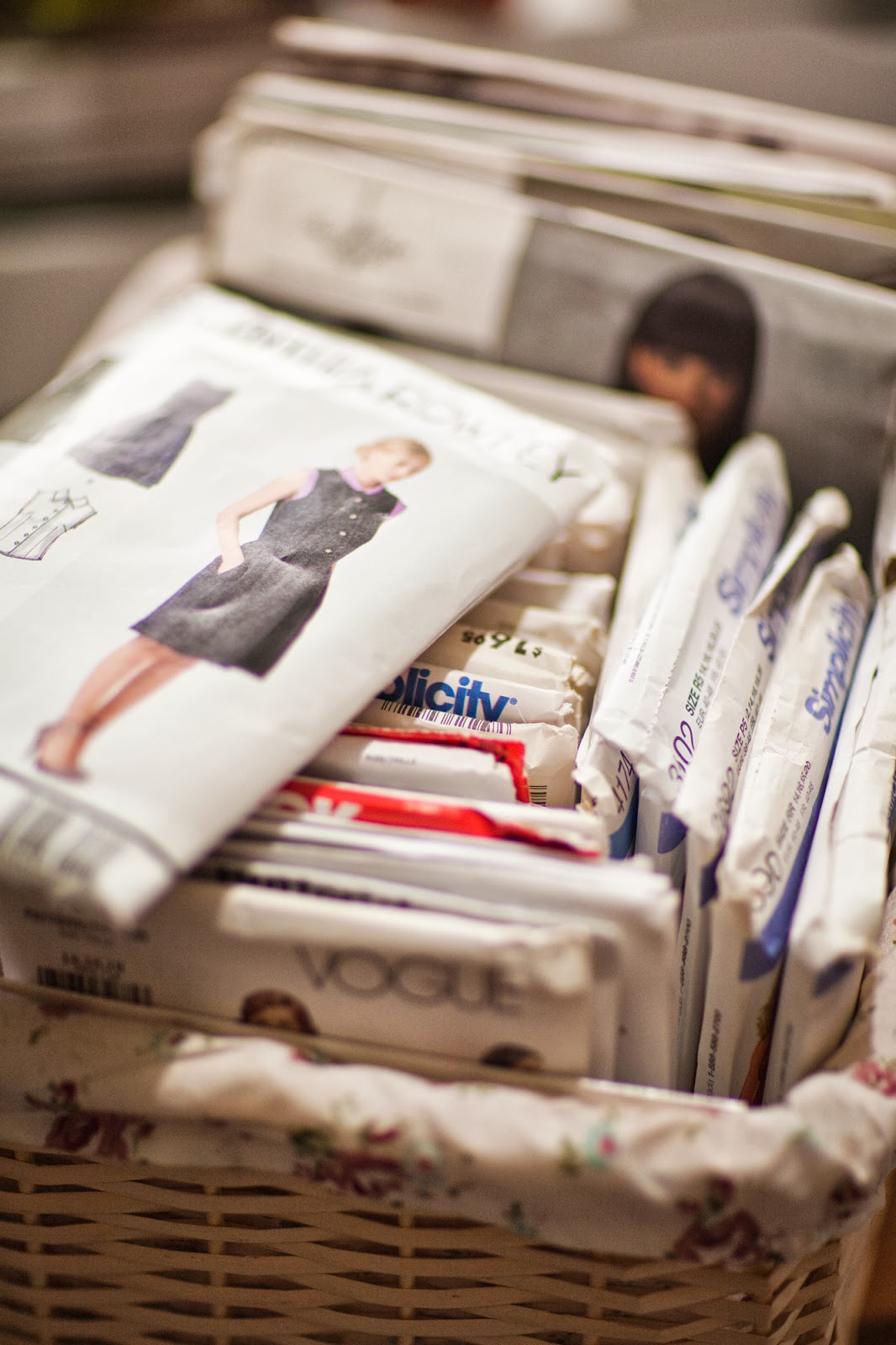
Searching for your pattern : You can search either in store via catalogues or online via the pattern company websites. I prefer to use the catalogues as you can gain more information from them and I find it easier to compare patterns to one another if I can see the actual product. Most stores that sell patterns have a variety of books to choose from, for instance at Sew Crafty we have New Look, Simplicity and McCalls patterns in stock and have Vogue and Butterick catalogues with the patterns to order. Usually you will search through the catalogues to find the design you like, then the sales assistant will find the pattern envelope in the stock drawers for you in the size that you need. 

Sizing : Check that the pattern is available in your size. We find that patterns come up at least one size smaller than you would buy in say Marks and Spencer's or Topshop. You can check your measurements for sizing in the back of the catalogues for a general guide, and specific sizing on the pattern itself. A good general rule to follow is that if you usually buy a size 12 in a ready made garment you will be best making a size 14 in a pattern. Luckily most patterns come in multi sized groupings, for instance (8-14) - (14-24) so you can be a little flexible. Be aware that the back of the pattern envelope will give you details for all the sizes, only the front will tell you the grouping you are buying. 

Measurements : The other thing that can be helpful when looking at size is taking your measurements before you go to look for patterns. Knowing your measurements in inches and cm is helpful when trying to choose a pattern. The garment measurements and size measurements are usually listed on the back of the pattern envelope (if not they will be on the instructions) and will give you a good indication of the size and length of the finished garment. This will let you know what the fit of the garment is like too, whether it is designed to be a tight  fit, or a loose baggy garment, how full the skirt will be etc.

Fabric : If you want a pattern to make a cotton dress, picking a design that is shown in thick wool is not going to work very well. Try and be guided by the fabric suggestions on the pattern envelope.

Style : When shopping for clothes we try and choose styles that suit our figures, do the same with patterns. You will never get a good result if you pick a style that is not what you would usually wear. 

Over ambitious : Try to pick a pattern that is relevant to your experience. If you choose a pattern that has lots of pieces and detailed seams, as a beginner, it can be too complicated and will end up being frustrating. Work your way up to details like pin tucks, detailed seams, intricate collars and sleeves. If you learn a different technique every time you try a pattern you will get a better result than trying to learn everything at once.

Catalogue drawings : Don't let the drawings or photographs in the catalogues put you off. I try to look at the small line drawings at the bottom of each page to get an idea of shape, rather than being put off by a fabric choice or an exaggerated illustration. 

This is Part 1 of 3 the next section which will explain more about the pattern envelope and what all that information is for. Parts two and three are now available to view, Part 2 here and Part 3 here.

Sammy xxx 

If you liked this post and like our blog, please pop over and vote for us in this years blog awards.
To keep up with all our latest posts follow us on Bloglovin

Make it: H and The never-ending Dress

Image Courtesy of www.sewessential.co.uk
About a year ago I embarked on a Dressmaking course at an Adult Education College in Hammersmith.  I wanted to learn more about how to use a pattern to make something rather than just knock things up in my own unique way!

I started with an easy 1960's shift dress style from Simplicity, I learnt how to measure myself, find out the size on the pattern, usually go the size bigger by the way, just to give you a bit of room to manoeuvre, as if like me you are a different size on top than on the bottom part of your body!

Then came the cutting, sewing, shouting, unpicking, Zip inserting (a concealed zip by the way!), Darting, more shouting, unpicking and then the basic shape was formed!  It then took me another 8 months to get around to finishing off the hems and seems and finally yesterday it was complete!  Please do excuse the chopped off head photo, it really was not a good look!


So, yes I did make it easy on myself and do it in black, rather than a bright or patterned print.  I thought it easier for my first attempt!  I am not completely happy with it, but a few things I can improve on is better for the next time, right!  At least I can wear it out of the house now as it's made of suiting fabric and so not ideal for the summer months!

My next challenge is to make a dress that doesn't take me 8 months to complete!!!  hmmmm, this could be harder than I thought!

Make it
H