Showing posts with label sewing machine. Show all posts

Top 10: Things to look for when buying a Sewing Machine

I get asked a lot at Sew Crafty what to look for when you are buying a new sewing machine, lots of our customers are intimidated by the sheer number of different kinds out there and where to even start looking. Here are my top ten tips for buying a new Sewing Machine. 
  1. Before you dive straight in, why not try and borrow a friend or relative's machine for a while and see how much you really use it and what kind of things you like sewing.  It will give you a better idea of what you like and don't like so you can make sure the machine you choose has those features.       
                                                                                                                    
  2. Be careful of picking a machine with too many bells and whistles. If it is your first machine you may be overwhelmed with too many stitch variations To start with keep it simple, you can always sell on your old machine and upgrade if you feel you are missing out.    
                           
  3. Always buy from a reputable source. I would always recommend buying from a bricks and mortar shop. If your machine is faulty or needs a service (it will eventually need one) you want a place you can go back to. It is not always possible of course so if you are buying online, head to a reputable company like John Lewis, and if you can, pay on your credit card so the purchase is insured.            
                                                                                                     
  4. The added joy of finding a shop that sells Sewing machines locally to you is that you can go and try them out. You can ask questions of the shop owners, they should have good experience and if you have your list of requirements and budget they can hopefully match you to your perfect machine.
                                                                                                                           
  5. Head to online guides like Which best buys or search online for reviews and recommendations for the machine make and model you are looking for.  
                                                                           
  6. Buy the best you can afford, like I always say in haberdashery you get what you pay for and in most cases this rings true with sewing machines too.  
                                                                       
  7. Try and choose a brand with parts that are easy to find locally or again from a reputable online source. It can be so annoying when you want or need to buy a new foot and you can't find where to get it from.                        
                                                                                                                 
  8. When you purchase your machine, find out where you can get it serviced. If you are buying locally you can often take it back to the shop for servicing, but if not you may need to contact an independent engineer. Your machine will need a service every year -18 months after the end of the guarantee to keep it running efficiently. Regular servicing will help to avoid larger repair bills and replacement costs further down the line.                  
                                                                    
  9. Your machine will need to be cared for. It will need cleaning and maintenance to help it run smoothly. Your machine manual will have information about how to dust and oil your machine to get the best results. It should be stored somewhere warm and dry. If it has been stored in the cold make sure you run it for a while to warm it before you start sewing.    
                                       
  10. Ask to see the instruction booklet. It will be your best friend when late night sewing. Your local machine shop owner will not appreciate late night phone calls to chat about tension, but your machine book, if it is a good one, will answer a lot of questions. It should also explain all the accessories and extras that you can get and how to use them. 
I hope that has guided some of you in the right direction when searching for your new sewing machine. If you have any questions, please leave them in the comments below and I will try my best to answer them. If you have already bought your machine and are struggling to enjoy using it, check out my post on How to Fall in Love with Your Sewing Machine

Have a great weekend and happy sewing!
Sammy xxx

Bloglovin / Twitter / Facebook / Pinterest / Google+ / Instagram

Top Ten Sewing Machine Feet

I am aware that there are in fact twelve feet in the picture above and even worse there are actually more than ten feet mentioned in this post, I never have been able to stick to a budget! I have been asked alot recently after introducing the Teflon foot in our Pastel and Neon clutch bag tutorial about sewing machine feet. There are lots of different kinds of presser feet depending on what you need to do and which machine you have. I thought today I would just run you through my ten...sorry twelve most used machine feet.
I have three machines, a Janome 525s a Babylock 1600 and a mint green John Lewis mini and I am lucky enough that they all take standard low shank snap on feet. I have used contrasting threads to make it easier for you to see what each foot is capable of. 

Zig Zag foot
The zigzag is the most versatile of all the feet that come with your machine. This is the foot that you cannot live without. With the ability to stitch almost any stitch through the oval opening, you would be lost without this little one.

Zipper foot
For sewing zips into anything a zipper foot is essential. Depending on your machine, your foot or your needle will shift from side to side to be able to get up close to the zip coil without the foot veering off the edge of the zip and without damaging the coil, so that you can attach your zips with neat straight stitches.

Concealed zip foot
You don't need a concealed zip foot to insert a concealed zip but it is jolly useful if you do. The foot helps to roll the coil of the zip away whilst you stitch so you can get as close to the edge as possible to make a neat closure with no stitching showing on the outside of the project. 

Teflon foot/ Walking foot
These two for me count as one foot, as they are both designed to aid in moving sticky, slippery or bulky fabrics through your machine. The Teflon foot is recommended for fabrics like PVC and leatherette where the surface has a tendency to stick to the underside of a metal foot. The walking foot can also help with this issue, but it can also be used for sewing bulky fabrics and slippery fabrics like Minky fleece which tend to shift when sewing with a regular foot. In the photo above you can see the results sewing on Minky fabric with the walking foot on the left and with a regular foot on the right. So much better with the walking foot I think you will agree. 

Blind Hem Foot
The amazing invisible hem that you can achieve from this foot and its corresponding stitch is brilliant. Sometimes practice is required to truly appreciate what a wonder this foot can be, but once mastered it is a skill you won't forget. 

Embroidery/darning foot
If you have a need to be free with your stitching, an embroidery or darning foot will be your best friend. Once you lower the feed dogs (the little rough teeth that move the fabric through with your other feet) the bouncy foot will hold the fabric whilst the stitch is being made but will jump up so you can move the fabric in any direction you wish. Great for creating stitched art, appliqué and free motion quilting. 

Gathering foot.
Again a rather specific use and a little temperamental but good fun if you are in the mood to play around a little. This foot will stitch and as the name suggests, gather your fabric as it goes. I find that it does better with light weight fabrics and small amounts, but it is a time saver when sewing long lengths of trimmings. 

Piping foot
You can get different sizes of foot depending on the size of your piping, but basically the groove in the bottom is designed to hold the cord in place whilst you stitch the casing or cover in place. You can also use it when sewing the covered piping between two layers of fabric. Like the zip foot with zips, it is designed to get the stitch as close to the piping as it can, so as  little of the stitching is visible on the finished product. 


Button hole foot/guide
As the name suggests it is there as a guide when sewing a button hole by machine. It usually has markings on it so that it is easy to judge the size you need whilst sewing (if you have a manual button hole stitch). It also holds the fabric in place all the way around the button hole area whilst stitching to get a neat even finish. 

Bias binding foot
Designed to make the dull task of sewing on bias binding a little easier. It holds the fold of the bias in place with consistency to get a straight line when sewing your binding on the straight or round a curve. You just wheel the guide in to place and sew!
Roll Hemming Foot
A simple and efficient way to get a narrow neat finishing edge is to use a roll hemmer. It is a little fiddly at first but once the technique has been mastered you will love it.  Really good for finishing edges on silk scarves and fine or sheer fabrics. 

There are a couple of things I would suggest if you are thinking of trying or buying any of these feet for your own machine. Make sure you buy the right foot for your brand of machine. Keep all your feet and accessories together in one place and keep it in a safe, clean and dry environment. If you are using a foot for the first time, or for the first time in a while practice on some scrap fabric before you sew on your final project... just in case.

If you are nervous about even approaching your machine check out our post about how to fall in love with your machine. Want to find out more about other sewing machine feet and more on how to use any of the feet specifically? You can head over to our friends at the Sewing Directory where they have more articles about all the feet I have mentioned and more.

Do you have a tool or technique that you love?  Is there something about sewing or crafts you have always wanted to know about?  Let us know, we would love to write some more posts like this.  Look out for my much requested 'Bias Binding' Top Tips special coming up next week.

Sammy xxx


Bloglovin / Twitter / Facebook / Pinterest / Google+ / Instagram

Sewing tips: Basics #2

We are just addicted to sharing our fave tips and tricks when it comes to sewing and crafts. We are diving into a second round of sewing tips today, don't forget to check out our previous tips Basics #1 and How to Fall in Love With Your Sewing MachineAlso why not check out my fabric buying tips and pattern advice from last year. Quite a mixed bag this time so lets get going....

Zips: Not sure about which size zip you need, don't panic Zips can be cut to size. If you buy one that is too long, as long as you stitch across the ends to stop the runner from coming off you can cut off the excess to make it the right length for your project.

Patterns: Make your patterns last longer by tracing them off onto greaseproof paper rather than cutting out from your pattern sheet. It means you never cut anything important away and if you need to make adjustments you don't spoil your original pattern papers.

Pattern Sizing: The big brand patterns, Simplicity, McCall's etc, often work from fashion sizing measurements not retail sizing measurements. You will often need to make up your patterns in a larger size than you would buy in the shops. If in doubt always check the body and garment measurements on each pattern and make to the size it recommends for your stats.

Fabrics: One thing we tell our customers at Sew Crafty all the time is to go home and wash their fabric before they start their projects. Even if you aren't using cotton fabric (which can shrink when washed) or the project you have in mind wont be washed afterwards, it is still worth giving it a rinse and an iron before you start to get rid of any dust or creases.

Tools: Invest in a small ruler, it is helpful to have a small measuring tool to hand so you don't always have to reach for your tape measure.

Storage: Rather than a pretty but not totally functional sewing basket for all your machine parts and sewing notions, why not invest in a tool box or vanity case. The mix of large and small compartments are perfect for keeping all those little bits and bobs in order.

Button Holes: Pop a pin in the end of your button hole to stop cutting too far and ruining your button hole.

Machine Stitching: Always check your machine top and bottom tension before you start to sew. If you have a bobbin case dangle it with the bobbin inside, if it shakes down slowly its perfect, if it falls it's too loose and if it doesn't move its too tight.

Seams: Always press your seams as you go, you will never regret it later.

Seating: Make sure your sewing machine chair is at a good height for your machine and is comfortable. But do make sure you get up and take breaks every so often, so you don't get too stiff.

Equipment: Always try and buy the best equipment you can afford. Cheap haberdashery is usually cheap for a reason. This is most important when referring to thread. The time it takes to make a garment to have the seams pop the first time you wear it is not worth the saving!

I hope these will be helpful, even if you are a seasoned machinist. Look out for our next tips post that I am working on at the moment all about Sewing Machine feet. As usual let us know your favourite tips in the comments below, we love to learn new tricks.

Sammy xxx


Bloglovin / Twitter / Facebook / Pinterest / Google+ / Instagram

How to Fall in Love With Your Sewing Machine

Did you get a shiny new sewing machine for Christmas? Do you have one, unloved and sitting in your cupboard? Nervous to get it out of the box? Please don't be, your machine can be your best friend if you learn how to love it. A lot of our customers in Sew Crafty tell me that they are a little intimidated by their sewing machine. They are afraid of doing something wrong and not being able to fix it. They find it frustrating and complicated, who has time for that!

Today I am going to let you in on the secret (not a very well kept one) that I tell all of my customers, a tool that is invaluable when tackling a sewing machine, whether you are new to sewing or an old hand. The best news is that you may already have one.....

Your instruction book.

Yes, Seriously, your instruction book. Now don't panic, if you have not a clue where yours is you can usually download the one for your model on the manufacturer's website. Take a note of your make and model and google away, for instance I have a Janome 525s so I would google 'janome 525s instruction manual' and you should be able to get a hold of it that way.  Usually as a PDF so you can print it off if you like too.

Now that you have your instructions at hand you can use them to find out most any thing you need to know. Most instructions don't just have set-up directions but usually they will talk you through all of the techniques that your machine can handle; including zips button holes and decorative stitching. It will tell you what presser feet you have and what they are used for and what settings you need to use for which fabrics. Mine even has a handy trouble shooting guide in the back.

I know that all the information in the manual can be a little overwhelming at first, but learning to drive a car is complicated until you learn how. Here are my top tips to get started:
  • Take some time out to get to know your machine and the techniques it is capable of. 
  • Use fabric scraps to practice stitches so you don't mess up your projects.
  • Don't rush, push, force, hurry or pull. No one likes that!
  • Always use the best needles and thread you can afford, your machine will thank you for it.
  • Change you needle regularly. 
  • Make sure you buy the right bobbins needles and feet. Take one that came with the machine along to your haberdashers with you to double check. 
  • Make a note of your make and model to keep in your purse when shopping for machine parts. 
  • Take good care of your machine. Find the name of a local sewing machine engineer and have your machine serviced after your guarantee ends. Then every two years after, regardless of how much you use it (even more important if it has not been used)
  • Set aside some time before you start a project to practice the steps you will need, practice makes perfect. 

I hope that has encouraged you to get your machine out from where it is hiding. Trust me, it could be the start of a beautiful friendship. Why not have a try this weekend? Do let us know how you get on.

Is there anything you want to know about starting to sew with a machine? Ask your question in the comments and we can see if we can help.

Sammy xxx


Bloglovin / Twitter / Facebook / Pinterest / Google+ / Instagram

Make it: Unicorn Hobbyhorse with free PDF download

This month of DIY gifts is so exciting for us because we get to share so many things to make for your family and friends. Today I'm going to show you how to make any of the little princesses in your lives squeal with joy. We are making a Unicorn Hobby Horse!  We have included a PDF download for this too so you can print it off and keep it handy for birthdays as well as Christmas time.

You will need: 1/2 metre of white fleece, 3 x 15cm by 75cm strips of coloured fleece, ribbon, toy stuffing, thread (normal and extra strong), a pole or stick, scraps of felt or fleece in black and a pretty colour, pins, scissors and a sewing machine (optional) glue (optional).

Start by drawing out your pattern or use the one we have provided and scale it up to size. Place the unicorn head piece on top of two layers of fleece and cut around the template leaving a 1.5cm seam allowance all the way around. Do the same for the ears and horn, making sure you cut two extra ear pieces from a pretty colour of felt to make the inside of the ears. Stitch all the way around your head shape leaving the bottom open and snip into the seam allowance at all the curves. Next, fold over the horn, pin down the straight edge and stitch it down to make a cone. Also stitch the ears leaving the flat edge at the bottom open, then turn everything right side out.

Next, take a square scrap of fleece and a handful of stuffing and make a ball on the end of your stick by wrapping some thread around the base, I have used an old fabric pole, ask at your local fabric shop if they have any spares you can have, or head to a DIY store and pick up some dowelling. Start to stuff your unicorn head until you reach the bend at the top of the head then insert your pole. Continue to stuff down the neck until you are about 7-9 cm from the base of the neck. Take some strong thread and stitch around the neck pulling it in tight at the base, wrap some pretty ribbon around to cover the stitching and to help keep it in place on your pole.

Next you are going to make the mane. Layer up your three colours of fleece strips and pin them together along the centre. Stitch all the way down the centre of the strips. Take your super sharp scissors and start to snip the strips all the way along both sides leaving 1.5 cm between the end of your cut and the centre line of stitching. You should end up with a lovely fleecy hair do for your unicorn.

Stitch the mane to the base of the neck and tack it in place along the neck seam until you get to the forehead of your unicorn, then fold it back on itself and carry on tacking it on until you reach the end of your mane piece.

It should look a little bit like a horse now, so it is time to make the horn. Take the cone you stitched earlier and stuff it. Stitch up the bottom of the cone with some strong thread and without cutting the thread take it and wrap it up and around the cone, pulling it tightly to create the spiral up the horn. Finish off by stitching through the tip of the horn and tying off your thread.

Fold the ears in half and taking your strong thread again, stitch them to the head either side of the mane, then stitch around the base of the horn. Lastly take a scrap of black felt and cut yourself some cute eyelashes and stitch or glue them onto the unicorn's face.

Here is a picture of the template I drew, you can easily download this picture (right click on your mouse and choose save as or download our PDF) scale it up and use it for your own template.

I am in love with this girl, I am going to be hard pushed to let her go, but the little girl who is getting her for Christmas is going to just love her even more than me I'm sure!

We would love to see what gifts you are making for your loved ones this year, link in the comments or #livelovemake on Instagram or twitter to show us your goodies. 

Sammy xxx


Bloglovin / Twitter / Facebook / Pinterest / Google+ / Instagram

Make it. a zipped make-up bag

Last week we were very upset as we had to cancel our Craft Club at Norden farm, because not enough people were booked on, this made us very sad as we were, as always, really looking forward to it.

The idea was to take the myth away from zips by making a zipped make-up bag. We had had so many requests for this kind of class it was a shame that not enough people wanted to come along this time.

Link for the week: Sewing Lego

Photo courtesy of www.suchitysuch.blogspot.co.uk
I found this little beauty on Pinterest the other day and couldn't resist showing it to you.  Why would you not want to make a little sewing machine out of Lego!  Combining Lego and sewing for me is my ultimate geek fest!

You can find the tutorial here:


I would love to see if anyone makes this or has any other fun items they make.  Leave a link below and we will take a look.

Make it
H

Love it: Sew Crafty Window Display Special


Last week I was invited by the Manager of the Nicholson's Shopping Centre in Maidenhead, to discuss a proposal she had for me. Intrigued, I went along to the meeting where she offered me the chance to use one of the empty shop units for a Great British Sewing Bee inspired display, to help advertise my shop. You may remember when we first took over Sew Crafty (Orxiom fabrics as it was then) we were residents of the centre. Lots of people to this day still ask if we are the shop that used to be there. Anyway, of course I jumped at the chance, Mostly because I love window dressing, I'm sure I get this from my Dad, as he used to fit window displays in Harrod's when he was a teenager. Also because as much as I love our window at work, it has its limitations, it was so fun to be let loose in a new, empty space.
I spent the week collecting together props and making examples to use in the display to best show off our products and on Friday my Dad and I spent the whole afternoon in Unit 27 setting up our display.

Here is what the unit looked like before, displaying some of Teresa Mills lovely mosaics. You can see that the window is spilt into four sections separated by a door.

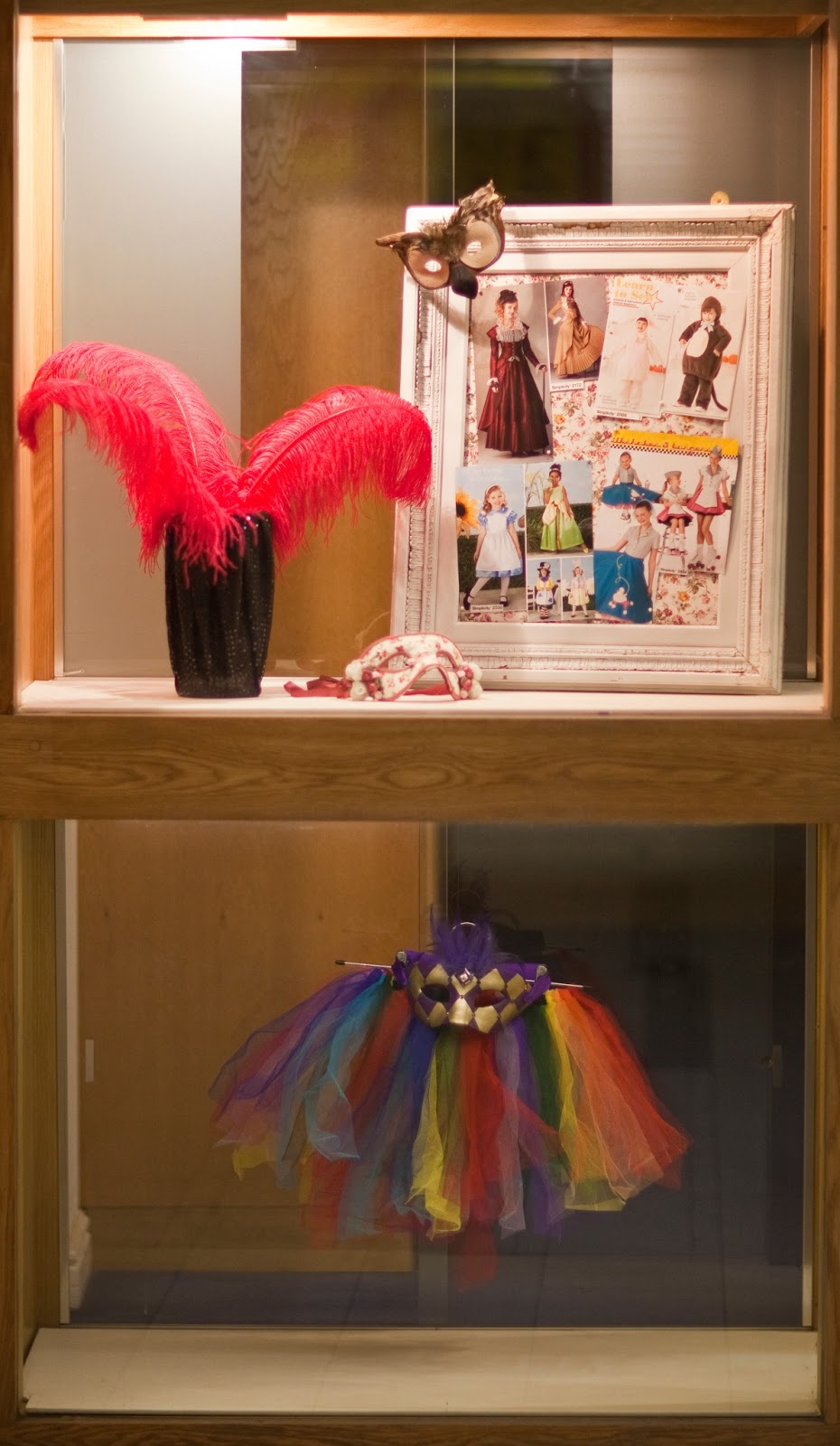
We used the two smaller sections to display costume ideas as we sell a lot of fabrics and accessories for making costumes. When the schools have Book week our shop is a busy place, we love helping parents out with costumes for their kids to play dress up! We have put a poster in a fabric covered frame to tell people where to come to get all their sewing goodies.

 The other two windows we dedicated to more traditional sewing fayre. We used the top window as a dream sewing table of sorts, with a mood board, a sewing machine and supplies, books, trimmings and yarns. The bottom window we used as more of a display space showing off some pieces we made from the show and some customising ideas.


We tried to use a mix of our products with some from mine and my mums collections, like you would have at home.

A glass dish with new and vintage buttons in front of a collection of Cloth magazines. The Sewing Bee book is on display surrounded by ribbons, fabrics and My Tilda bunny.

I set up a little design station too with a sketch book and samples in front of our mood board, which is brimming with cuttings and ideas from Company and  Cloth magazine.


I was really pleased with the end result, it looks like a work space any respectful sewer would be proud of. Hopefully it will inspire a few people to take the short walk down to our end of the High Street and pay us a visit.

This is the pretty little sheared dress my Mum made, the same as the one they made on episode 3 of the Sewing Bee. The Sewing machine is on loan from the lovely Anna (aka Thumbelina design) and the mug is mine that I use at work that was a gift from my friend Claire for my birthday, I'm missing it already!

Hope you enjoyed that little peek at our display, if you want to come down and take a look for yourself it's in Unit 27, opposite Iceland in the Nicholson's Shopping Centre, Maidenhead until the 29th of June. Whilst you here, you can pop down and see us at Sew Crafty (3 High Street, Maidenhead) at the same time!

Sammy xxx